How to choose your ski pole size?
1. According to your height
General rule:
A well-fitted ski pole should allow you to form a right angle (90°) between your arm and forearm when you hold it vertically, tip on the ground.
For a quick estimate:
Pole length = your height × 0.7
| Skier's Height (cm) | Recommended Pole Length (cm) |
|---|---|
| 140 cm | 95 cm |
| 145 cm | 100 cm |
| 150 cm | 105 cm |
| 155 cm | 110 cm |
| 160 cm | 110 cm |
| 165 cm | 115 cm |
| 170 cm | 120 cm |
| 175 cm | 120 cm |
| 180 cm | 125 cm |
| 185 cm | 130 cm |
| 190 cm | 135 cm |
| 195 cm | 135 cm |
| 200 cm | 140 cm |
Always round down if you are between two lengths.
2. According to your practice
Classic alpine skiing
Choose rigid poles suited to your height (see table). They provide support in turns and offer stability.
Ski touring
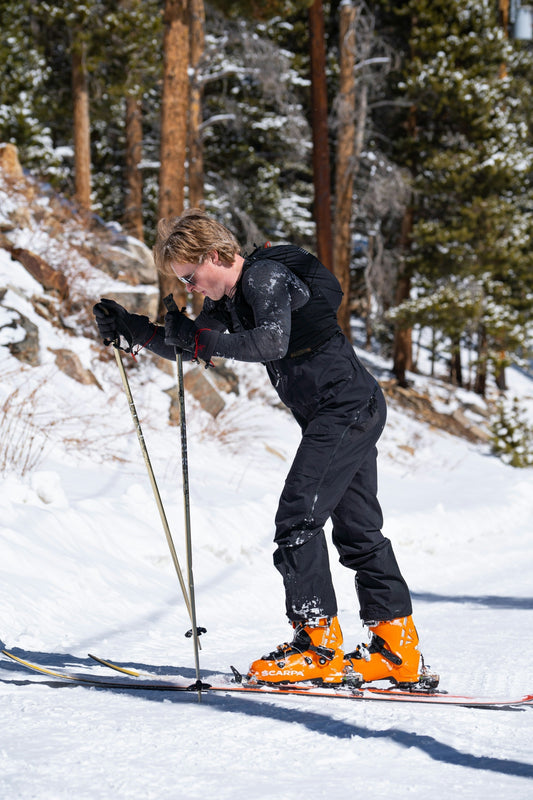
Opt for telescopic or adjustable poles. This allows you to adapt the length according to the slope: shorter for steep climbs, longer for descents or flat terrain.
Steep skiing / ski mountaineering
Short and light poles are recommended. They avoid clutter and facilitate kick turns in technical sections.
Freeride / off-piste skiing
Slightly shorter or adjustable poles allow for better balance in powder.
3. According to pole type
- Fixed poles: stronger and lighter, suitable for alpine skiing.
- Adjustable poles (2 sections): ideal for hiking, splitboarding, or long approaches.
- Foldable poles (3 sections): very compact, convenient to carry, but sometimes less robust.
Common mistakes to avoid
- Choosing poles that are too long, which unbalances posture and complicates movements.
- Neglecting the choice of baskets: in powder, large baskets prevent poles from sinking too deep.
- Using uncomfortable grips or poorly adjusted straps.
- On tours, not using adjustable poles limits adaptation to the terrain.
Expert tips
- For ski touring, adapt the length to the slope:
-> steep climb: shorter poles
-> traverse: medium length
-> descent: poles the same length as for alpine skiing
- Check the reliability of the locking system (on adjustable models), especially in cold weather or with gloves.
- Choose a pair of lightweight but robust poles, especially if you frequently ski in the mountains or on varied terrain.
The choice of your ski pole size depends primarily on your height, but also on your practice and the terrain. Well-adjusted poles improve balance, reduce fatigue, and increase safety. For both touring and downhill, they are a real support, literally and figuratively.
To find all the advice for choosing the right size for your equipment, visit our ultimate guide here
👉 Discover our selection of NEW winter sports accessories on Equinox Outdoor and find the equipment perfectly suited to your needs.